 Nuclideon
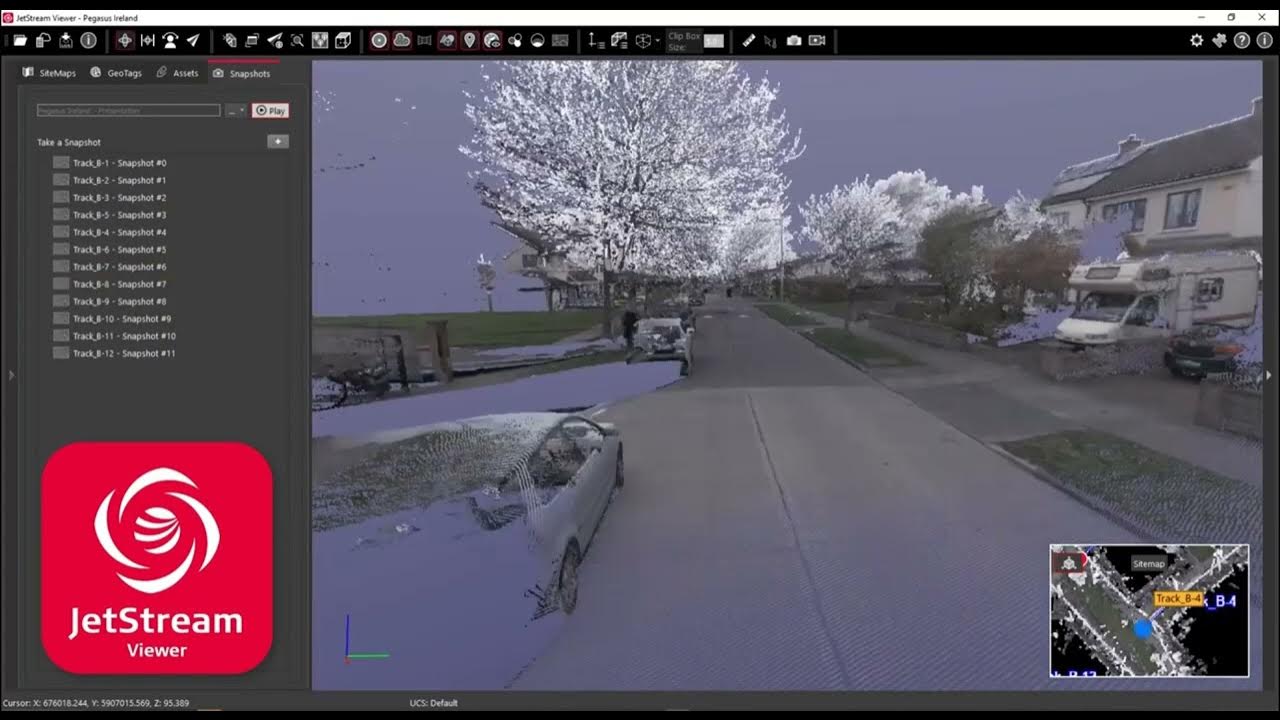
Leica Geosystems ran a third-party rendering engine at the core of JetStream for close to a decade. That engine handled unlimited point cloud scale with no GPU, no load times, and no resolution degradation. It became the foundation for LGS, Leica's own data standard. The company that built it no longer exists. Nuclideon acquired the technology, rebuilt it, and is now offering it as an SDK.
How the engine ended up inside Leica's products
Leica embedded the Unlimited Detail engine into JetStream, their high-speed point cloud rendering product. The file format they built for the pipeline, LGS, was designed around the same underlying data architecture and became the data standard for Leica's point cloud pipeline.
Leica is the global market leader in terrestrial laser scanning. Every scanner in their lineup, including the BLK360, RTC360, BLK2GO, BLK2FLY, and ScanStation P-series, produced data that flowed through the LGS ecosystem. They ran this architecture for close to a decade, serving 30,000+ users.
SDK prospects regularly ask whether the technology has been proven at enterprise scale. The Leica deployment answers that. A flagship product from the market leader, where the integration ran for close to a decade before the relationship wound down across a 30,000-user base, is a different kind of reference than any benchmark we could run in a lab.
What went wrong, and what it means for Nuclideon
The technology performed. The support relationship didn't.
Euclideon's commercial execution broke down. The support relationship with Leica wound down years before the company entered administration. None of the management responsible for that breakdown have any affiliation with Nuclideon.
Nuclideon acquired Euclideon's assets in 2025, inheriting an engine with a decade of enterprise validation and one clear lesson: the technology had never been the problem.
Nuclideon is founder-led. Paul Fox, the Euclideon engineering lead, serves as CTO. He rebuilt the engine with modern APIs, broader format support, and a support model built for long-term SDK partnerships. Our read is that the technology was never the issue. The support and commercial execution were. We built Nuclideon around fixing that specific failure.
What udSDK does
udSDK embeds the Unlimited Detail rendering engine into third-party platforms. Software companies, systems integrators, and platform developers use it to handle large-scale 3D point cloud data without building a rendering engine from scratch.
No GPU required. The engine runs entirely on CPU, which means it works on standard laptops, embedded systems, air-gapped environments, and cloud VMs without GPU provisioning. GPU-dependent rendering is a tax on every deployment. You pay it in infrastructure costs, compatibility constraints, and provisioning delays. udSDK eliminates the dependency entirely.
Unlimited scale. The engine handles trillions of points without degradation. Terabyte-scale datasets load in real time. The resolution at 100 million points is the same as at 100 trillion. This is architectural, not a setting. Competing solutions manage scale through subsampling, level-of-detail switching, or streaming latency. udSDK doesn't make that trade.
Air-gapped deployment. The engine can run fully offline with no cloud dependency. Defence and intelligence programmes, classified environments, and critical infrastructure work all require offline operation. Few rendering solutions meet that requirement without significant modification. We built udSDK for it from the start.
Modern APIs and format support. The original Euclideon SDK was built for a different era. udSDK ships with clean APIs, support for LAS, LAZ, E57, UDS, and other major formats, and integration documentation developers can use. The path from evaluation to embedded integration is measured in weeks.
Direct engineering support. SDK integration is a long-term technical relationship. You get direct access to the engineering team, not a ticketing queue or a reseller chain.
Who should be talking to us
Embed udSDK once and every product you ship gains the rendering capability, along with every downstream user. Leica demonstrated that model: one integration, an entire software portfolio. We're opening udSDK to platform developers who want the same leverage.
Defence and intelligence. Platforms requiring air-gapped deployment, classified environment compatibility, and real-time rendering of large-scale terrain and infrastructure datasets. Defence is our highest-priority vertical. We are currently working with US Navy programmes that have these requirements today.
GIS and survey platforms. You're building on point cloud data at enterprise scale and your rendering is the bottleneck. udSDK removes it without a rebuild from scratch.
Spatial AI and digital twin platforms. 3D spatial analysis infrastructure needs enterprise-grade rendering from day one. Engineering teams evaluate, decide fast, and integrate in weeks. That's the conversation we're built for.
What a conversation looks like
We demonstrate the engine on your data, your hardware, in a 20-minute call.
Bring a dataset from your use case, whatever scale your current pipeline struggles with. We run it through udSDK live. Seeing it work on your data moves things faster than anything we could send you to read. If the engine fits, we talk about integration. If it doesn't, you've spent 20 minutes.
The engine has ten years of proof. The question is whether it fits your pipeline. Twenty minutes tells you.
API documentation and SDK access are at nuclideon.com. For platform and enterprise enquiries, reach us at udsdk@nuclideon.com.
Nuclideon attending Geo Week in Denver
Come say hi!
The GPU Was Never the Right Tool for Point Clouds. The Shortage Just Made It Obvious.
Your GPU queue is 26 weeks. Memory prices are up 90%. NVIDIA shelved its professional line through 2028. That is not a shortage. That is a permanent reallocation. The architecture was already failing you before it happened.