Your team captured 7.82 terabytes of LiDAR. Your tools showed you 10% of it.
Your data is massive. Your tools are not.
of your captured data goes unseen.
Traditional tools downsample, tile, and decimate your point clouds before rendering begins. Your analysts work from an approximation of reality.
per GPU over a 5-year lifecycle.
Hardware is only 35% of the bill — power, cooling, staffing, and idle capacity multiply the rest by 5×. Infrastructure your field teams can’t carry, your classified networks won’t permit, and your CFO can’t defend.
to move your captured dataset to an analyst in the field.
At 2Mbps satellite bandwidth, those 4 terabytes sit six months away from anyone who needs them. Your classified network bans cloud transfers outright. GPU-dependent platforms need infrastructure your operating environment will never have.
Sensors get cheaper. Capture density increases with every product cycle. Your datasets grow, and your tools cannot keep up. They force you to cut the data to fit the tool.
You have been accepting this tradeoff because no alternative existed. That changed.
The team that solved unlimited-scale rendering. Twice.
Paul Fox, Nuclideon's CTO, and the development team, spent over a decade building a CPU-native algorithm that searches trillions of 3D points in real time and renders only what is visible on standard hardware. No GPU. No downsampling. No compromise on what the sensor captured.
Leica Geosystems licensed that engine to power their JetStream product line. 30,000+ users across the global survey industry ran on the Unlimited Detail engine. Production infrastructure for one of the largest geospatial companies on earth, running for close to a decade before the commercial relationship wound down.
The company that commercialized it, Euclideon, entered administration. Commercial execution broke down. The technology never stopped performing.
In August 2025, Paul Fox and Kristian Wares acquired the assets, cleared the debt, and incorporated Nuclideon. The engineering team that built the Unlimited Detail™ engine owns it again.
The team that built the technology rebuilt the company around it. In the first six months, Nuclideon contracted the US Navy, Lockheed Martin, and the Queensland Government. The patents are granted. The customers are paying. The engine runs.


Nuclideon's patented Unlimited Detail™ engine searches your entire point cloud every frame, retrieving only the points visible at your current view. Rendering cost stays constant whether the dataset is 1 gigabyte or 200 terabytes. CPU-native. No graphics card.
Claims mean nothing without deployment evidence. Here is what Nuclideon delivers in production, today, for organizations with zero tolerance for vendor promises.

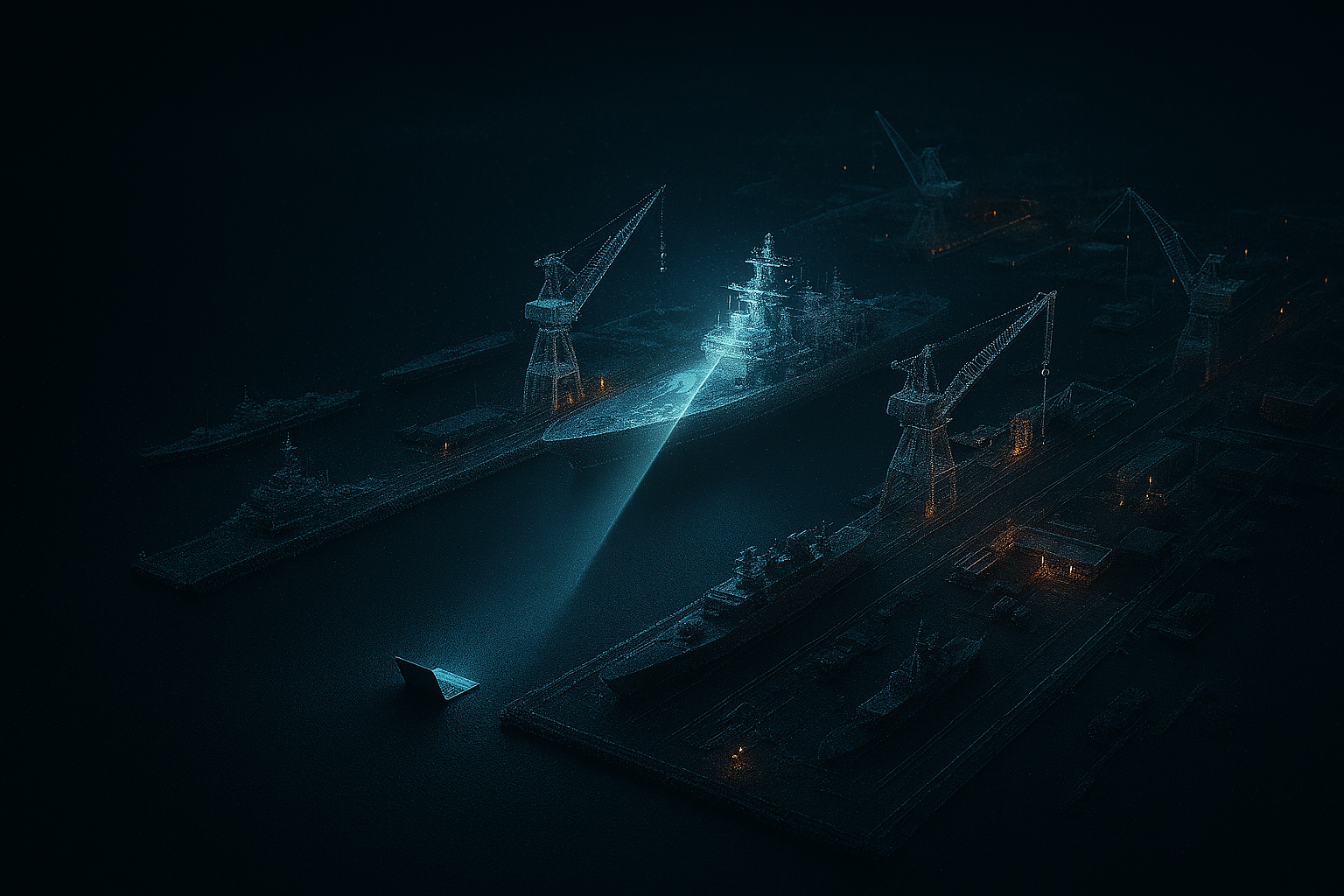
Full-resolution 3D digital twins of naval assets, rendered in real time on standard-issue hardware. Full data fidelity, streamed inside your classified network.
171,000+ geoscience datasets from the Geological Survey of Queensland, navigable in a single 3D environment. Exploration geologists zoom from state-wide geophysics to individual borehole textures without switching tools. Built with UQ Sustainable Minerals Institute and the Department of Resources.
Leica Geosystems embedded the Unlimited Detail engine into JetStream and shipped it to 30,000+ users across the global survey industry. The integration ran in production for a decade.

Each product maps to a deployment scenario. Pick the path that matches your environment. Combine them if your organization spans multiple.
Your experts make decisions on the full captured dataset, not a sample. On-premise, air-gapped, or offline, on the hardware they already carry. Collaborate together via udCloud on whatever device they can access.
Securely store and access datasets on any device, anywhere and then work collaboratively to analyze and share insights.
The rendering engine as a library. Leica embedded it into JetStream. Defence primes and GIS integrators build on it. Now you can too.
Five questions. Answered before you ask them.
GPUs are exceptional at what they were built for: gaming, ML training, real-time graphics with polygon meshes. For those workloads, GPU rendering is the right answer.
Point cloud data is a different problem. Datasets run to terabytes, not triangles. The bottleneck is not shading. It is finding which points to shade. That is a search problem, and search is what CPUs do best.
Nuclideon's patented algorithm works exactly this way: spatial indexing and per-pixel search, running entirely on CPU. No GPU anywhere in the stack. Shipped to 30,000 users via Leica. Running in US Navy classified environments today.
Nuclideon is new. The technology is not. Over a decade of R&D and more than $40 million in development preceded Nuclideon's acquisition of the IP, patents, and codebase. Five of the original senior developers are shareholders and actively building the platform today.
The company runs on customer revenue, not investor cash, with zero debt. That is a deliberate choice: the previous company's commercial model ran ahead of demand. Nuclideon ships what customers are paying for, and the customers who were paying before administration resumed their contracts almost immediately after incorporation.
You don't. Nuclideon is not a replacement for your GIS, BIM, or asset management tools. It solves the problem they can't: rendering and streaming massive point cloud datasets at full resolution, on commodity hardware, at any scale.
udSDK embeds directly into your current systems. udStream and udCloud sit alongside them. Your existing workflows stay intact. We extend your investment, not compete with it.
Hopefully they will want to partner with us to integrate our technology into their platforms, but we are not going to wait around for that. We will sell direct to their customers and let the market decide whether they want to integrate or lose business.
The clue is in the name. Nuclideon kept the technology, the patents, and the engineering team that built them. Everything else is new: new ownership, new commercial model, zero legacy debt. The people who wrote the code now run the company.
That is where we started. udStream was built for environments without public internet and no tolerance for data leaving the network. The cloud-connected version came second.
udCloud deploys the same behind an air gap as it does on AWS. Same features, same permissions model, same collaboration tools. The US Navy runs it on classified networks today. No call-home licensing (optional). No data leaves the boundary.
70% to 80%+ lower infrastructure cost. Real numbers.
GPU infrastructure for point cloud visualization costs $3.5M to $5.5M per year at 10,000 users. Nuclideon replaces that entire GPU stack with per-seat licensing starting from $150/seat/year, scaling to $100/seat/year at enterprise volume. Here is the comparison.
| Scale | GPU Infrastructure | Nuclideon udSDK | Saving |
|---|---|---|---|
| 250 users | $130K–$178K/yr | $37.5K/yr | 71%–79% |
| 1,000 users | $522K–$711K/yr | $120K/yr | 77%–83% |
| 5,000 users | $1.8M–$2.8M/yr | $550K/yr | 69%–80% |
| 10,000 users | $3.5M–$5.5M/yr | $1M/yr | 71%–82% |
Above 10,000 seats, pricing is negotiated. The percentage saving increases further at scale because GPU costs grow linearly with users while udSDK per-seat rates decrease at volume.
udStream and udCloud license on a per-seat or per-site basis. Contact us for a site-specific TCO model built on your user count, deployment environment, and data scale.
GPU cost estimates based on industry-average infrastructure pricing. Nuclideon pricing from the udSDK Pricing Model (effective April 2026). Request a site-specific model for your environment.
See it on your data before you commit to anything.
Nuclideon does not ask you to sign a contract based on a slide deck. We ask you to send us your hardest dataset. The one that crashes your current tools. The one your team has been working around for months.
We load it. We render it at full resolution on standard hardware. We walk you through the result. On your network if required.
Send us your dataset. If Nuclideon cannot render it at full resolution on standard hardware, you owe us nothing. If it works, you have the evidence you need to make the decision. No commitment until you have seen the result.
Every customer in Nuclideon's portfolio started with a proof of concept. Lockheed Martin did not take our word for it. They sent their data. We rendered it. They signed.
Lab Director
US Navy
Your data doubles every two years. Your tools don't.
Every month you wait costs roughly $50,000 per thousand users in GPU infrastructure. That number only grows.
Nuclideon eliminates that cost. Today. On hardware you already own.
Don't accept a fraction. We show you everything.
Unlimited Detail is the patented rendering engine behind every Nuclideon product.